

 русский
 Español
 عربى
عربى
Automated Shelving: Types, Benefits & Industrial Storage Solutions
 2026.06.16
 Industry News
Content
- 1 What Automated Shelving Systems Are and Why They Matter
- 2 Core Types of Automated Shelving in Industrial Settings
- 3 Automated Shelving for Sheet Metal: A Specialized Application
- 4 Automated Storage for Long Materials: Pipes, Profiles and Bars
- 5 Key Benefits That Justify the Investment
- 6 Integrating Automated Shelving with Handling Equipment and Software
What Automated Shelving Systems Are and Why They Matter
Walk through a conventional industrial warehouse and you will see the same pattern repeated: workers moving between wide aisles, forklifts navigating around each other, staff spending significant time locating the right material before the actual work of retrieving it can begin. This model has served manufacturing for decades, but its inefficiencies have become harder to absorb as labor costs rise, floor space grows more expensive, and production schedules demand faster material turnaround.
Automated shelving — more formally known as Automated Storage and Retrieval Systems (AS/RS) — replaces this manual pattern with computer-controlled mechanisms that store and retrieve materials precisely, rapidly, and without requiring staff to physically navigate storage areas. A control system logs every item's location at intake, directs the retrieval mechanism to the correct position on demand, and delivers the material to an operator at an ergonomically correct access point. The operator never enters the storage zone.
The shift toward automated shelving has moved from niche application to mainstream industrial strategy. According to insights from the MHI's Automated Storage and Retrieval Systems Industry Group, adoption is accelerating across manufacturing and logistics, driven by converging pressures: chronic labor shortages, tightening floor space availability, and the competitive imperative to move materials faster with fewer errors. For metal fabrication, sheet processing, and structural material operations specifically, the case for automation has never been clearer.
Core Types of Automated Shelving in Industrial Settings
Automated shelving is not a single technology — it is a family of systems, each engineered for different material types, throughput requirements, and facility constraints. Understanding the distinctions is the starting point for any meaningful procurement decision.
Vertical Lift Modules (VLMs) use two columns of trays — one on each side of a central extraction unit — that move vertically to deliver the requested tray to a fixed access opening at the front of the machine. VLMs are the most space-efficient solution for facilities with available ceiling height, as they replace sprawling horizontal shelving with a compact vertical footprint that can reach 15–30 meters high. They suit medium-weight items stored in trays or bins and are widely used in parts warehouses, tool stores, and spare parts operations.
Horizontal carousels rotate a series of bins or carriers around a horizontal oval track, bringing the requested carrier to the operator's position. They are fast for high-frequency picking of small to medium items but require significant floor area and are best suited to environments where retrieval speed per item is the primary metric.
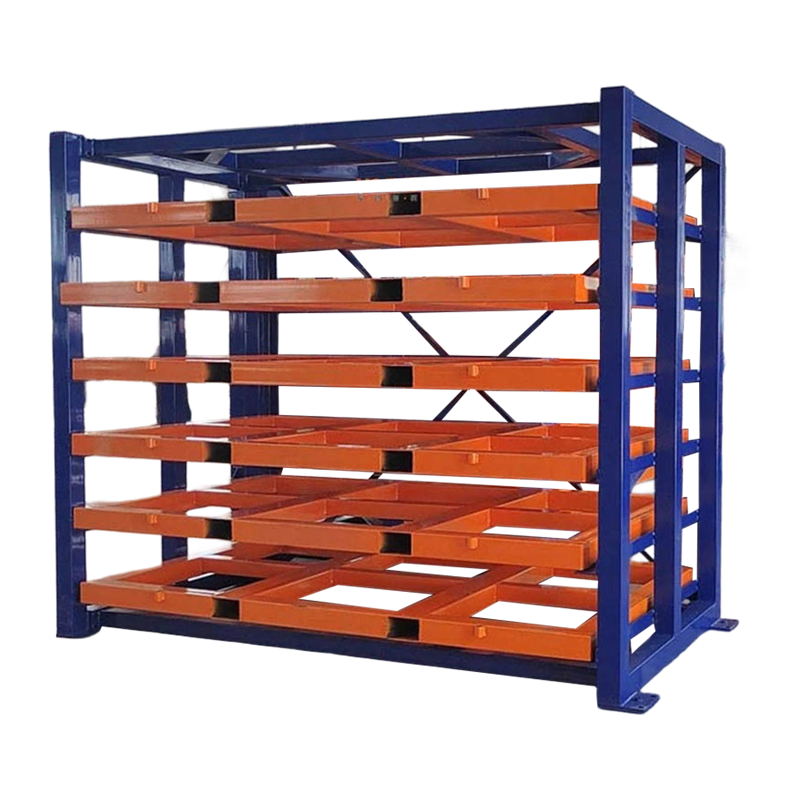
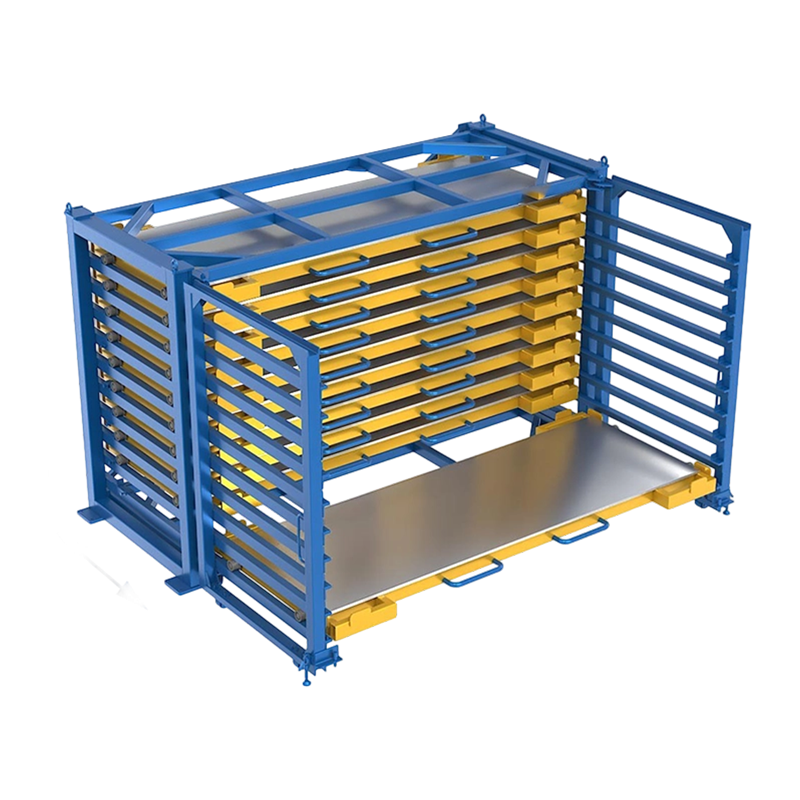
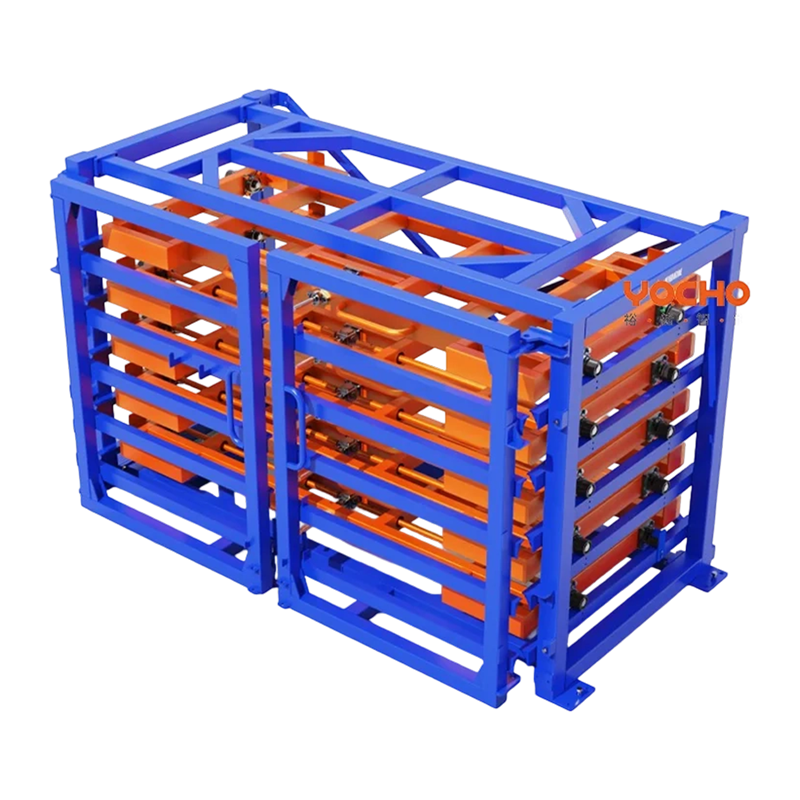
Drawer-type automated rack systems are purpose-designed for flat, heavy materials — most significantly sheet metal. Rather than rotating or lifting trays, these systems use motorized drawer mechanisms that slide individual storage cassettes out to the operator at floor or working height, eliminating the need for forklifts or overhead cranes at the point of access. Each drawer is independently addressable by the control system.
Stacker crane systems (unit-load AS/RS) deploy a crane mechanism running on a fixed rail within a narrow aisle between tall rack structures. The crane moves horizontally and vertically to place and retrieve pallets or large loads at any rack location. These systems handle the heaviest loads and highest storage densities and are the backbone of fully automated high-bay warehouses in automotive, steel, and distribution sectors.
| System Type | Retrieval Mechanism | Best For | Space Advantage |
|---|---|---|---|
| Vertical Lift Module (VLM) | Vertical tray elevator | Parts, tools, small-medium items | Uses ceiling height, small floor footprint |
| Horizontal Carousel | Rotating oval track | High-frequency small item picking | Moderate — requires floor area |
| Drawer-type Rack | Motorized sliding cassettes | Sheet metal, flat heavy materials | High — replaces wide forklift aisles |
| Stacker Crane (Unit-load) | Rail-mounted crane in narrow aisle | Pallets, heavy bulk loads | Very high — narrow aisles, tall racks |
Automated Shelving for Sheet Metal: A Specialized Application
Sheet metal storage presents a set of challenges that standard shelving — automated or manual — handles poorly. Raw sheets and cut blanks are heavy (a single 3000×1500mm steel sheet can weigh several hundred kilograms), dimensionally large, prone to surface damage from contact and abrasion, and difficult to identify visually when stacked. In conventional manual storage, retrieving a specific sheet from a stack requires a forklift, a skilled operator, and often the removal and re-stacking of multiple sheets lying above the target material. This process is slow, damages surfaces, and carries real injury risk.
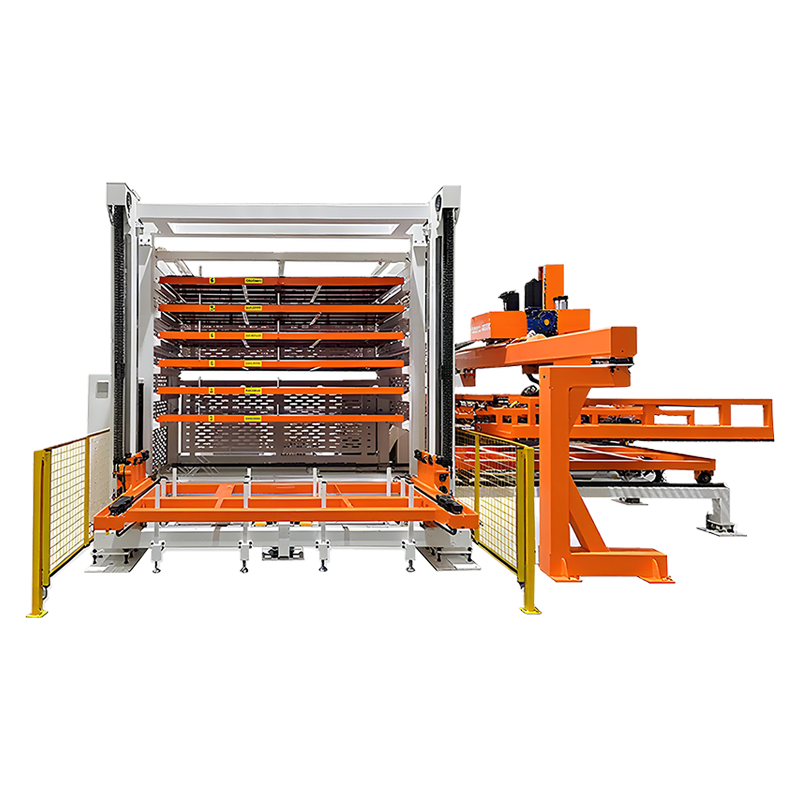
Automated drawer-type sheet metal rack systems resolve all of these problems in a single architecture. Each sheet or batch of sheets occupies its own independent cassette or drawer, registered by material type, thickness, alloy grade, and quantity in the system's inventory database. When a cutting machine or press requires a specific material, the operator inputs the request at a terminal — or the system receives it automatically from the connected MES or ERP — and the motorized mechanism retrieves the correct drawer and presents it at the loading station. No forklift enters the picture. No sheets are moved unnecessarily. The material arrives at the operator undamaged and correctly identified.
The space savings from this approach are substantial. Sheet metal stored in conventional horizontal stacks with forklift access aisles requires significant floor area per tonne of material. A drawer-type automated system consolidates the same inventory into a fraction of the footprint by eliminating aisle space and stacking cassettes compactly within the rack structure. Explore the full range of automated sheet metal storage rack systems for industrial workshops, including solutions scaled for both small batch and high-volume sheet processing environments. For facilities requiring full automation of sheet intake and retrieval, the automated sheet metal storage systems with drawer-type access integrate directly with upstream and downstream processing equipment to create a continuous automated material flow.
Automated Storage for Long Materials: Pipes, Profiles and Bars
Long materials — steel tubes, aluminium extrusions, structural sections, round and flat bar stock — present a different set of storage challenges from sheet metal but equally poor outcomes under manual storage regimes. Conventionally stored on static cantilever racks or in floor bundles, long materials require overhead crane or forklift access for retrieval, consume large floor areas due to the aisle clearance their length demands, and create serious safety hazards when workers manually handle lengths that may exceed 6 meters and weigh hundreds of kilograms.
Identifying the correct profile within a mixed inventory is another persistent problem. Structural steel sections of similar appearance but different grade or wall thickness are frequently confused in manual storage environments, leading to costly material misidentification errors that only surface after cutting or fabrication.
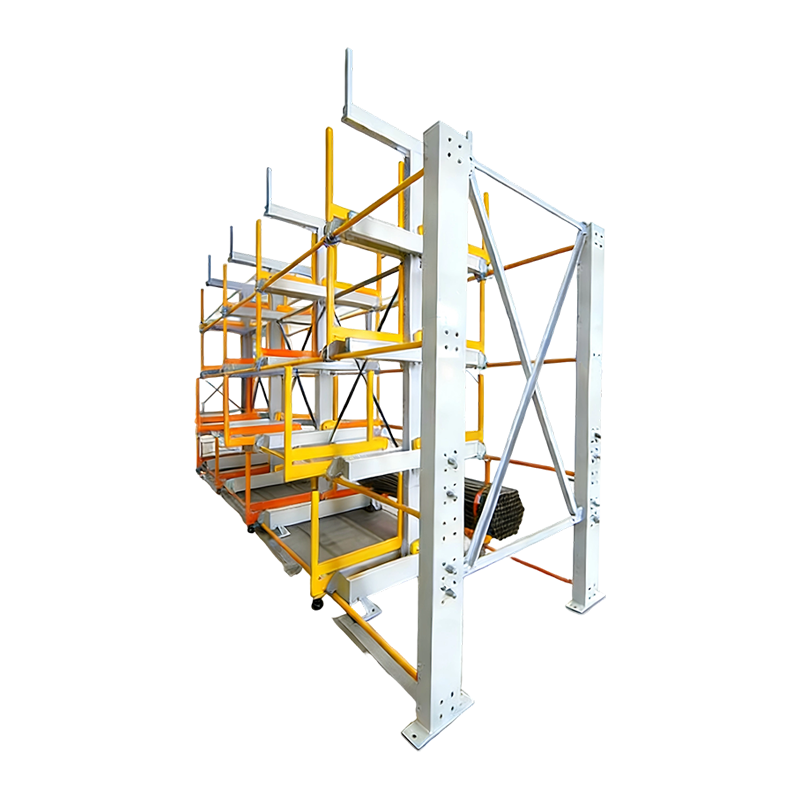
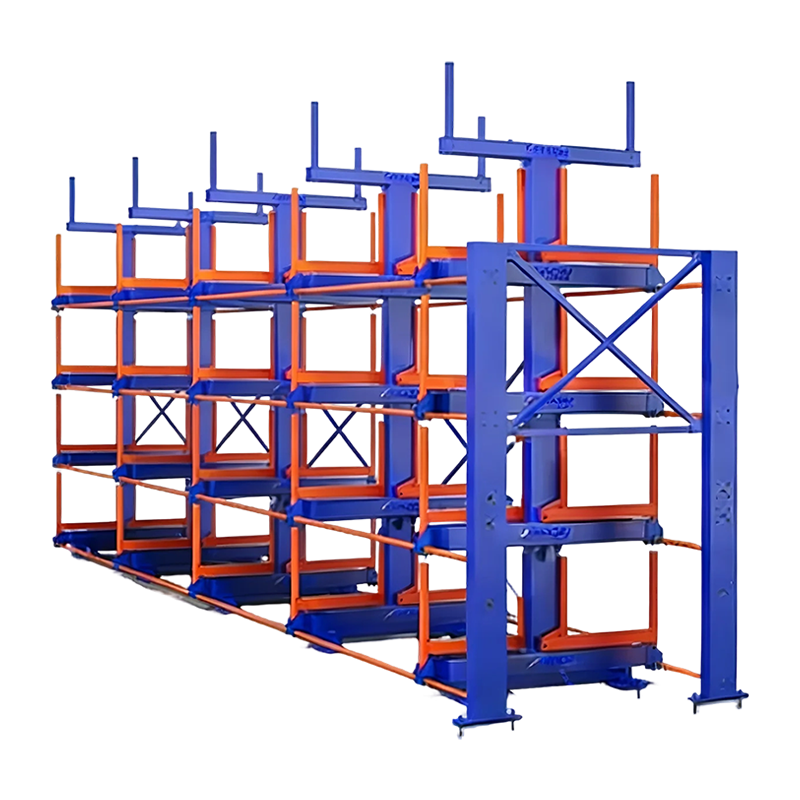
Automated storage systems for long materials address these issues through motorized cassette or telescopic cantilever mechanisms that retrieve specific material lengths and deliver them to an operator access point without any crane or forklift involvement. The system's inventory database tracks each cassette's contents — material type, grade, length, quantity — and manages first-in-first-out sequencing automatically. The automated storage systems for long materials including pipes and profiles serve exactly this need, combining compact storage architecture with precise retrieval control for tube, bar, and section inventories of any complexity.
For facilities that need automated retrieval capability without full system automation, motorized electric telescopic cantilever shelves provide an intermediate step: the cantilever arms extend automatically to bring the requested material to the access face, eliminating crane operations while retaining the familiar cantilever rack format that long-material operations have standardized around.
Key Benefits That Justify the Investment
Automated shelving systems carry a higher upfront cost than conventional racking, and that cost is frequently the first objection raised in capital approval discussions. The business case for automation becomes compelling, however, when the full cost of manual storage — not just the rack purchase price — is put on the table.
Space reclamation. Automated systems eliminate the wide aisles that forklift access requires. In a typical industrial facility, aisle space accounts for 30–50% of total floor area dedicated to storage. Replacing conventional racking with automated shelving in the same space can double or triple storage capacity, or alternatively allow a portion of the existing floor area to be redeployed to productive manufacturing use. For facilities operating near capacity, this reclaimed space often has a value that alone justifies the investment.
Inventory accuracy. Manual picking systems depend on human attention to select and record each retrieval correctly. Industry estimates place mispick rates in manual warehouses at rates that translate to thousands of dollars annually in rework, write-offs, and customer impacts. Automated systems achieve inventory accuracy rates of 99.9% or above, as the control system tracks every movement and prevents the ambiguity that causes manual errors. For sheet metal and long material operations, this accuracy directly reduces material waste from wrong-grade processing.
Labor efficiency and safety. Automated shelving brings material to the operator rather than sending the operator into the storage zone. This eliminates the physical strain, travel time, and injury risk associated with manual retrieval from tall racks or heavy material stacks. Fewer staff are needed for material handling, and those staff work in safer, more controlled conditions. Labor cost reduction is typically the largest single contributor to the financial case for automation.
Return on investment timeline. Despite significant upfront cost, AS/RS systems in manufacturing environments frequently achieve ROI within 6 to 18 months when labor savings, space value, inventory accuracy improvements, and reduced material damage are all accounted for. The payback period shortens further in high-labor-cost markets and in operations running multiple shifts where the 24/7 capability of automated systems provides throughput that manual operations cannot match without proportional staffing increases.
Integrating Automated Shelving with Handling Equipment and Software
An automated shelving system operating in isolation delivers significant value. A system integrated into the broader material flow of a manufacturing facility — connected to handling equipment, production scheduling, and enterprise software — delivers transformational value.
The physical integration point is the loading and unloading interface. In a fully automated material flow, sheets or long materials arrive at the storage system from inbound logistics, are inducted into storage automatically via a loading manipulator, and are retrieved and delivered to the cutting or processing machine without manual intervention at any stage. The intelligent loading and unloading manipulators for automated material handling complete this loop — handling the physical transfer of material between the storage system and the production equipment with precision that manual forklift operations cannot consistently achieve.
On the software side, the control system of a modern automated shelving installation typically supports integration with Warehouse Management Systems (WMS), Manufacturing Execution Systems (MES), and ERP platforms. This integration enables the storage system to receive material replenishment triggers automatically when inventory falls below threshold, to release material to production on schedule according to the production plan, and to update inventory records in real time without manual data entry. The result is a storage function that is not just faster and more accurate, but genuinely connected to the production operation it serves.
For operations seeking a complete solution rather than individual components, the complete automated storage systems for manufacturing environments combine storage racks, retrieval mechanisms, handling equipment, and control software into integrated packages engineered for the specific demands of metal fabrication and processing workshops — from small-batch job shops to high-volume continuous production lines.
| Integration Level | Components Involved | Key Benefit |
|---|---|---|
| Standalone automated rack | Storage system + local controller | Space savings, faster retrieval, inventory accuracy |
| + Loading manipulator | Rack + manipulator arm | Eliminates manual induction / forklift at intake |
| + WMS / MES integration | Rack + software connection | Real-time inventory, automated replenishment triggers |
| Full automated material flow | Rack + manipulator + ERP/MES + machine interface | Lights-out material handling from inbound to machine |

If you are interested in our products, please consult us
PRODUCTS
NEWS CENTER
MOBILE TERMINAL

CONTACT US
- ADDRESS: Room 205, Office Building, Shandong Yurui Machinery Group Co., Ltd., at the intersection of Banqiao Road and Huangjin Road, Pingyi Street, Pingyi County, Linyi City, Shandong Province.
- PHONE: +86-19819101584
- EMAIL: [email protected]
Linyi Yocho Storage Intelligent Manufacturing Co.,Ltd. ALL RIGHTS RESERVED. ALL RESERVED. Warehouse Rack Manufacturers Warehouse Shelves Factory
