

 русский
 Español
 عربى
عربى
Long Loads Storage Safety: OSHA Compliance, Risk Control & Best Practices
 2026.05.25
 Industry News
Content
- 1 Why Long Loads Create Unique Storage Hazards
- 2 OSHA Standards That Govern Long Load Storage
- 3 Load Capacity Rules and Weight Distribution
- 4 Preventing Roll-Off and Lateral Shift
- 5 Safe Forklift and Overhead Crane Interface
- 6 Inspection, Labeling, and Maintenance Protocols
- 7 Safety Checklist for Long Load Storage Facilities
Why Long Loads Create Unique Storage Hazards
Standard warehouse safety thinking is built around palletized loads: discrete, rectangular units with a defined footprint and a stable center of gravity. Long loads—steel bar, pipe, aluminum extrusion, timber, plastic profiles—violate nearly every assumption in that model. Their weight is distributed across an extended length, meaning the leverage forces applied to storage arms, cradles, and support points are fundamentally different from those generated by a pallet. A cantilever arm carrying a 400 kg load distributed across 1.5 meters experiences very different bending moments than the same weight concentrated on a pallet beam.
Three hazard mechanisms are unique to long load storage and demand specific controls:
- Roll-off: Round stock—pipe, bar, tube—has no inherent stability when stored horizontally. Unlike a pallet that stays where it is placed, a single round bar will roll freely if unconfined. A 6-meter steel bar rolling off a storage arm at 3 meters elevation generates impact energy sufficient to cause fatal injury. End stops, arm incline, and bundling straps are all engineering controls targeting this specific mechanism.
- Lateral shift: Long loads extend beyond the support arms on which they rest. If a piece shifts laterally, it can engage an adjacent rack column, fall into a working aisle, or trap a worker between the moving load and a fixed structure. This risk is highest during forklift loading and unloading, when the piece is in motion and control is partial.
- Leverage amplification: The cantilever arm is a lever. A 500 kg load applied at the tip of a 1,200 mm arm generates a bending moment at the column connection that is structurally very different from 500 kg centered on a beam. Overloading—even slightly—on a cantilever arm produces non-linear increases in stress at the connection point. Rack collapses involving long material storage frequently begin with a single overloaded arm, not a catastrophic structural failure across the system.
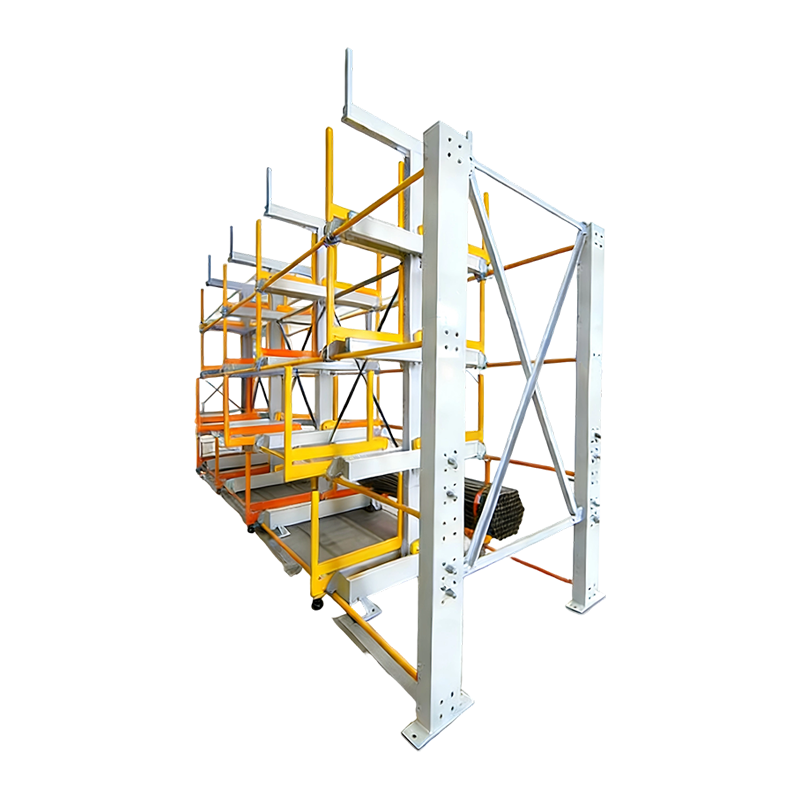
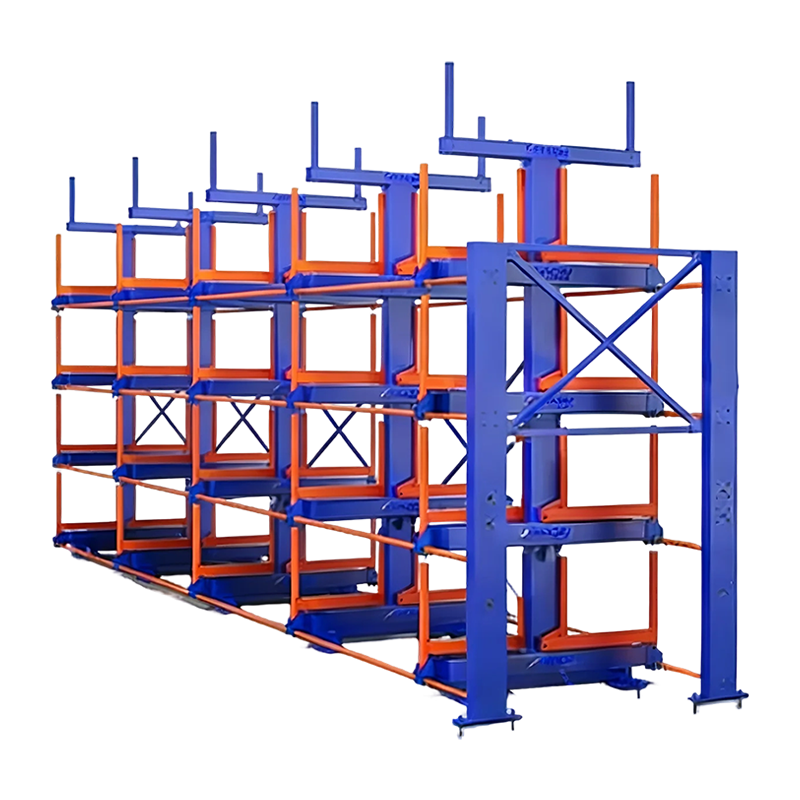
Purpose-built long material storage racks engineered with rated arm capacities, end stops, and column bracing address all three mechanisms at the design level. The safety protocols below govern how those systems must be operated and maintained once installed.
OSHA Standards That Govern Long Load Storage
Long load storage in the United States is governed by two primary OSHA regulatory frameworks, both of which apply simultaneously to most industrial warehouse operations:
29 CFR 1910.176 – Handling Materials (General Industry): This standard addresses material storage in general industry workplaces, including manufacturing facilities, metal service centers, and fabrication shops. Key provisions relevant to long load storage include:
- Stored materials must not create hazards. Materials stacked in tiers must be stacked, blocked, interlocked, or limited in height to prevent sliding or collapse.
- Storage areas must remain free of accumulation of materials that constitute hazards from tripping, fire, explosion, or pest harborage.
- Mechanical equipment operating areas—including forklift aisles adjacent to long load racking—must be kept clear and in good repair.
29 CFR 1926.250 – General Requirements for Storage (Construction): This standard applies to construction sites and covers material storage at project locations where long loads such as rebar, structural steel, and lumber are commonly staged. It requires that materials stored in tiers be secured to prevent sliding, falling, or collapse, and that access to stored materials not create tripping or falling hazards.
In addition to these regulations, OSHA inspectors apply the General Duty Clause (Section 5(a)(1)) to any rack-related hazard not specifically covered by a vertical standard. This clause requires employers to provide a workplace free from recognized hazards that are causing or likely to cause death or serious physical harm. A cantilever rack system with missing end stops, illegible load placards, or visibly damaged arms creates exactly the type of recognized hazard that triggers General Duty Clause citations—regardless of whether the specific deficiency matches a numbered OSHA standard.
The OSHA Warehousing Hazards and Solutions resource provides the authoritative guidance document for material storage safety in warehouse environments and should be the starting point for any compliance review.
Load Capacity Rules and Weight Distribution
Every component in a long load storage system carries a rated capacity that must be respected absolutely. Exceeding any single rated component—an arm, a column, a base anchor, or a floor section—puts the entire system at risk, because structural failure in racking typically progresses from one point of overload across adjacent components in rapid sequence.
The following capacity rules apply universally across cantilever and beam-based long load storage systems:
- Arm capacity is not additive: Each arm has an individual rated capacity. The total load on a column is the sum of loads on all arms, but each arm must stay within its own rated limit. A column with 10 arms rated at 500 kg each has a maximum column capacity of 5,000 kg only if each arm carries no more than 500 kg. Loading one arm at 800 kg while others carry less does not average out—the overloaded arm fails independently.
- Apply a 10–15% safety margin below rated capacity: Dynamic forces during forklift loading and unloading routinely exceed the static weight of the material by 20–30%. Maintaining a deliberate margin below the nameplate rating absorbs these peak forces without approaching structural limits.
- Heavier stock always goes lower: The fundamental weight distribution rule for long load racking places the heaviest material on the lowest arm levels and progressively lighter material on higher levels. This lowers the system's center of gravity, improves column base stability, and reduces the bending moment on the column at its most vulnerable mid-section.
- Distribute load evenly across arm width: Material resting diagonally across arms—with more weight shifted to one side—creates a torsional load on the arm that it is not designed to resist. Arms are engineered for vertical loading perpendicular to their axis. Ensure all loads are placed squarely and symmetrically across the arm width.
- Know your floor's capacity: OSHA 29 CFR 1910.22 requires that floor load limits be posted and respected in areas where mechanical materials handling equipment operates. A fully loaded cantilever system concentrates significant point loads at anchor positions. Verify that the floor slab specification supports the installed rack system's maximum load before commissioning.
Preventing Roll-Off and Lateral Shift
Roll-off and lateral shift are the most common proximate causes of injury in long load storage environments. Both are preventable through a combination of hardware controls and operational discipline:
End stops (arm stops): Vertical pins, bars, or welded brackets at the tip of each cantilever arm physically prevent material from sliding off the end. End stops must be rated for the lateral force that could be applied by rolling stock, not merely positioned as visual markers. For pipe and round bar, end stops should project a minimum of 100 mm above the top of the stored material at maximum stack height. Check that end stops are present, undamaged, and securely attached before any loading operation.
Inclined arms: Arms sloped slightly upward toward the column (typically 3–5 degrees) use gravity to bias round stock toward the column rather than the open end. This passive control reduces roll-off risk even if an end stop is momentarily absent or fails. Inclined arms are standard specification for pipe and tube storage on cantilever systems.
Bundling and strapping: Individual pieces within a larger bundle should be strapped together at intervals not exceeding 3 meters along the bundle length. Strapping prevents individual pieces from separating from the bundle during handling and eliminates the roll-off risk associated with loose individual items. In seismic zones or high-traffic areas, supplementary chain or cable restraints securing the bundle to the arm or column are an additional control layer.
Lateral shift guards during handling: Forklift operators loading or unloading long material must approach the rack face squarely, not at an angle. An angled approach induces lateral momentum in the load that the operator may not be able to counteract before the piece contacts an adjacent column or swings beyond the arm. Painted approach lines on the aisle floor, visible to the operator, enforce correct approach geometry during normal operations.
Minimum support points: Long material should rest on a minimum of two arm levels for pieces up to 6 meters, and three arm levels for pieces over 6 meters. Single-arm support for long, heavy material creates a see-saw condition where the load can pivot over the support point and fall. Check that arm spacing is correct for the material lengths being stored before each loading cycle.
Safe Forklift and Overhead Crane Interface
The loading and unloading interface between materials handling equipment and long load racking is where the majority of racking damage and related injuries occur. Both forklift and crane operations require specific spatial and procedural controls:
Aisle width: OSHA's minimum aisle width standard for forklifts is the width of the vehicle plus 900 mm for one-way traffic, or vehicle width plus 1,800 mm for two-way traffic. In long load storage aisles, the additional challenge is the load itself—a forklift carrying a 6-meter pipe extends the effective vehicle length well beyond the forklift body. Aisle width calculations must account for the full length of the longest load, including any overhang beyond the forks, when turning into or out of the storage zone.
Approach speed and deceleration distance: All forklift operations in long load storage aisles should be conducted at reduced speed—typically no more than 8 km/h in working aisles. Loaded forklifts with long overhang require significantly longer stopping distances than unloaded vehicles. Speed limit signage at aisle entries, enforced through operational supervision and reinforced in operator training, is the primary administrative control.
Overhead crane clearance: Where overhead cranes or hoists are used for long load extraction, the crane runway must provide clearance over the full height of the loaded rack system plus an additional 500 mm minimum of hook approach height above the top of the stored material. Verify this clearance calculation against the rack's maximum possible load height, not just its current loaded height.
Exclusion zones during loading: No personnel should be present in the loading aisle while forklift or crane operations are in progress. Physical barriers—chain barriers, retractable posts, or locked gate systems—enforce this exclusion without relying solely on verbal warnings or painted floor markings that workers may step across inadvertently.
Inspection, Labeling, and Maintenance Protocols
Long load racking systems must be inspected, labeled, and maintained on a defined schedule. The following protocols reflect industry best practice aligned with ANSI/RMI MH16.1 and OSHA General Duty Clause expectations:
Load placard requirements: Every rack system must display a visible placard at the end of each aisle stating the maximum permissible unit load per arm level and the maximum total load per column section. Placards must be legible from the aisle floor without approaching the rack face. Illegible, missing, or incorrect placards are among the most commonly cited rack-related OSHA violations.
Inspection frequency: Conduct a formal documented rack inspection at three intervals:
- Daily visual check: Operators and floor supervisors verify that no arms are bent, no end stops are missing, no material is incorrectly placed or overhanging, and no debris is accumulating at rack bases. This check takes less than 10 minutes per aisle and should be documented in a logbook or digital checklist application.
- Monthly structural check: A designated safety officer or rack supervisor inspects each column for visible deflection, base plate condition, anchor bolt integrity, and column plumb. Any column that has deviated more than 3 mm per meter of height from vertical should be immediately offloaded and evaluated by a qualified rack engineer before returning to service.
- Annual third-party inspection: A rack safety engineer or the original rack manufacturer's representative conducts a comprehensive inspection including load placard verification, system documentation review, and written compliance report. This annual inspection provides the documentation required to demonstrate due diligence in OSHA enforcement proceedings and supports insurance coverage requirements.
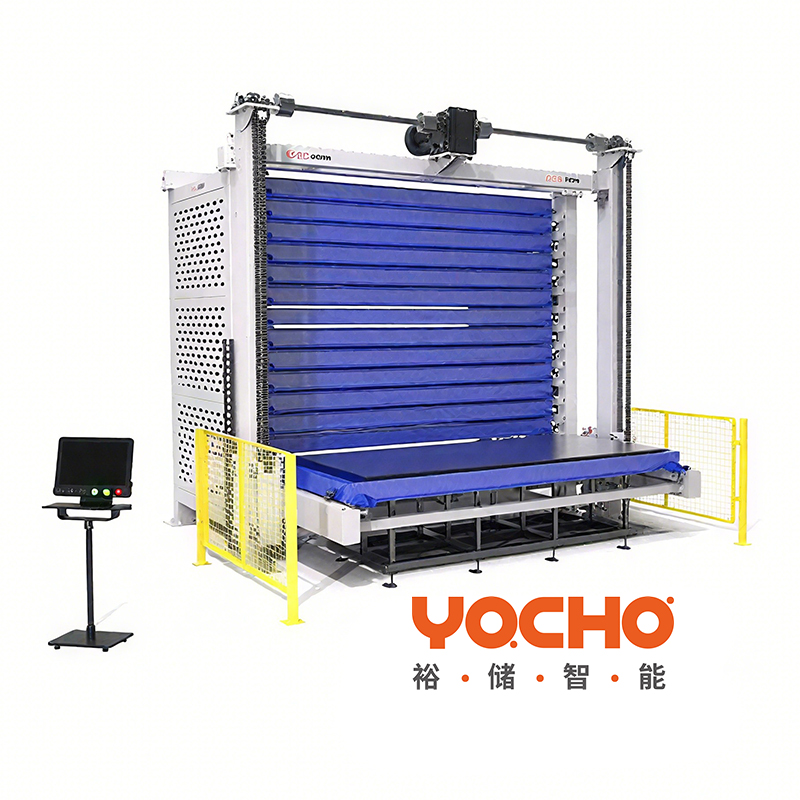
Damage response protocol: Any rack component that has been struck by a forklift, shows visible bending, cracking, or deformation, or whose welds appear compromised must be immediately taken out of service—load removed, area cordoned off, repair evaluated by a qualified engineer before any material is returned to the affected section. "Straightening" a bent rack arm in the field is not an acceptable repair; bent structural steel has been compromised at the crystalline level and will fail at a fraction of its original rated load. Our automated storage solutions—including automated sheet metal storage systems—eliminate forklift access to the storage zone entirely, removing the primary cause of impact damage to racking.
Safety Checklist for Long Load Storage Facilities
Use this 10-point checklist during monthly safety audits and as an onboarding reference for new personnel responsible for long load storage operations:
| # | Inspection Item | Standard / Basis | Pass Criteria |
|---|---|---|---|
| 1 | Load placards visible and legible at each aisle end | ANSI/RMI MH16.1 / OSHA General Duty | Legible from aisle floor without entering rack face |
| 2 | All arm end stops present, secure, and undamaged | Facility engineering standard | No missing, bent, or loose end stops on any arm |
| 3 | No arm exceeds its individual rated load | 29 CFR 1910.176 / ANSI/RMI MH16.1 | All arms loaded within rated capacity less 10–15% margin |
| 4 | Heaviest material on lowest arm levels | Industry best practice / stability | No arm at height carries material heavier than arm below it |
| 5 | Round stock bundled and end-stopped | Facility safety standard | All round material bundled ≤3 m intervals; end stops engaged |
| 6 | No columns visibly deflected beyond plumb tolerance | ANSI/RMI MH16.1 (3 mm/m) | All columns vertical within 3 mm per meter of height |
| 7 | Aisle widths unobstructed and within specification | 29 CFR 1910.22 / OSHA forklift standards | No material, debris, or equipment encroaching on marked aisles |
| 8 | No damaged arms in service | OSHA General Duty Clause | Any bent or deformed arm is offloaded and tagged out of service |
| 9 | Base plates and anchor bolts intact | Rack manufacturer specification | All anchors present, tight, and free of visible corrosion or shear |
| 10 | Previous inspection findings resolved and documented | OSHA recordkeeping requirements | All findings from prior audit have documented corrective action and closure date |
Maintaining a consistent record of completed checklists—with dated signatures from the responsible inspector—creates the compliance documentation trail that OSHA expects to see during an investigation following a rack-related incident. Facilities that demonstrate a proactive, documented inspection program consistently receive more favorable outcomes in enforcement proceedings than those that rely on informal or undocumented safety practices. The physical integrity of your long material storage rack systems is only as reliable as the inspection and maintenance program supporting it.

If you are interested in our products, please consult us
PRODUCTS
NEWS CENTER
MOBILE TERMINAL

CONTACT US
- ADDRESS: Room 205, Office Building, Shandong Yurui Machinery Group Co., Ltd., at the intersection of Banqiao Road and Huangjin Road, Pingyi Street, Pingyi County, Linyi City, Shandong Province.
- PHONE: +86-19819101584
- EMAIL: [email protected]
Linyi Yocho Storage Intelligent Manufacturing Co.,Ltd. ALL RIGHTS RESERVED. ALL RESERVED. Warehouse Rack Manufacturers Warehouse Shelves Factory
