

 русский
 Español
 عربى
عربى
Long Loads Storage: Systems, Configurations & Selection Guide
 2026.05.20
 Industry News
Content
- 1 Why Long Loads Demand Purpose-Built Storage
- 2 Five System Types for Long Loads Storage
- 3 Cantilever Racking: The Industry Standard
- 4 Honeycomb and Pigeonhole Systems: Maximum Storage Density
- 5 Automated Long Load Storage Solutions
- 6 Key Selection Criteria: A Decision Matrix
- 7 Floor Space vs. Vertical Space: Calculating the ROI
Why Long Loads Demand Purpose-Built Storage
Long loads—steel pipes, aluminum extrusions, lumber, rebar, plastic tubing, rolled fabric, and structural profiles—share a storage problem that standard pallet racking cannot solve: their length. A 6-meter steel bar stored on the floor occupies a fixed footprint for its entire length, blocks adjacent inventory, creates a trip and roll hazard for anyone working nearby, and provides no protection against surface damage from contact with the ground or other materials. When dozens or hundreds of such pieces accumulate, the warehouse floor becomes a liability rather than an asset.
The consequences are measurable. Facilities relying on floor stacking for long materials report up to 35% more usable floor space recovered after installing purpose-built racking, and a 50% reduction in material handling injuries, according to 2025 research from the Material Handling Institute. Beyond injury reduction, proper long load storage eliminates the bending and warping that occurs when unsupported lengths rest unevenly across other materials—damage that is invisible at intake but becomes costly when a customer rejects deformed stock.
The market offers five distinct system architectures for long loads storage. Each serves a different combination of load type, weight, retrieval frequency, and floor plan. Choosing the wrong one means paying a capital cost for a system that either underperforms or overcomplicates daily operations. The sections below break down each option and the conditions under which it is the correct specification.
Five System Types for Long Loads Storage
Long loads storage systems are not interchangeable. The following five categories represent the core architectural approaches available to warehouse planners, metal service centers, fabrication shops, and distribution facilities:
- Cantilever racking: Horizontal arms projecting from vertical columns. No front-facing uprights. The dominant solution for variable-length, irregularly shaped, or very heavy stock requiring forklift or crane access.
- Honeycomb (pigeonhole) racking: A grid of individual horizontal tubes or channels, each holding a single bundle or piece. Extremely high storage density with individual location control. Best for high-SKU-count operations where piece-level traceability is essential.
- Vertical (upright) storage systems: Materials stored on end in vertical dividers or slots. Minimizes floor footprint for shorter lengths. Common in workshops and fabrication cells where floor space is the primary constraint.
- Dynamic (flow) long load systems: Inclined rails allow stock to flow forward under gravity as front pieces are removed. Suited to high-turnover operations with consistent material cross-section where FIFO rotation is required.
- Automated long load storage systems (ALSS): Computer-controlled retrieval mechanisms that deliver specific bundles or lengths to a fixed output point. The highest-density, lowest-labor option for operations with large inventories and consistent material profiles.
Cantilever Racking: The Industry Standard
Cantilever racking is the most widely deployed long loads storage system globally, and for good reason: it accommodates the widest range of material types, lengths, and weights without requiring a fixed compartment geometry. Arms are positioned at any height along the column in 75–100 mm increments, adjusted without tools in most modern systems, and extended or shortened as inventory profiles change over time. No other system offers the same combination of flexibility, load capacity, and accessibility.
The system consists of three structural elements: the base (a floor-anchored foundation providing lateral stability), the column (the vertical upright carrying all transferred loads), and the arms (horizontal projections on which materials rest). Arms are available from 300 mm to 1,800 mm in length; the practical rule is to select arm length at least equal to the full depth of the stored material, with no overhang exceeding half the upright spacing at the end arms.
Two construction methods define the structural performance tier:
- Roll-form (light to medium duty): Manufactured from cold-rolled steel sheet, bolted assembly, arms typically rated up to 700 kg each. Faster to install, cost-effective for loads under 1,500 kg per arm. Interior use preferred.
- Structural (heavy duty): Hot-rolled I-beam or C-channel construction, bolted with high-strength fasteners, arms rated from 900 kg to over 3,000 kg each. Suitable for outdoor yards (galvanized finish available), overhead crane loading, and environments with forklift impact exposure.
Configuration options further define the system's spatial performance:
- Single-sided: Arms on one face only. Placed against a wall to maximize floor space. Best where wall perimeter storage is the primary strategy.
- Double-sided: Arms on both faces of the same column. Doubles storage capacity per column footprint. Requires aisle access from both sides; optimal for free-standing installations in the warehouse body.
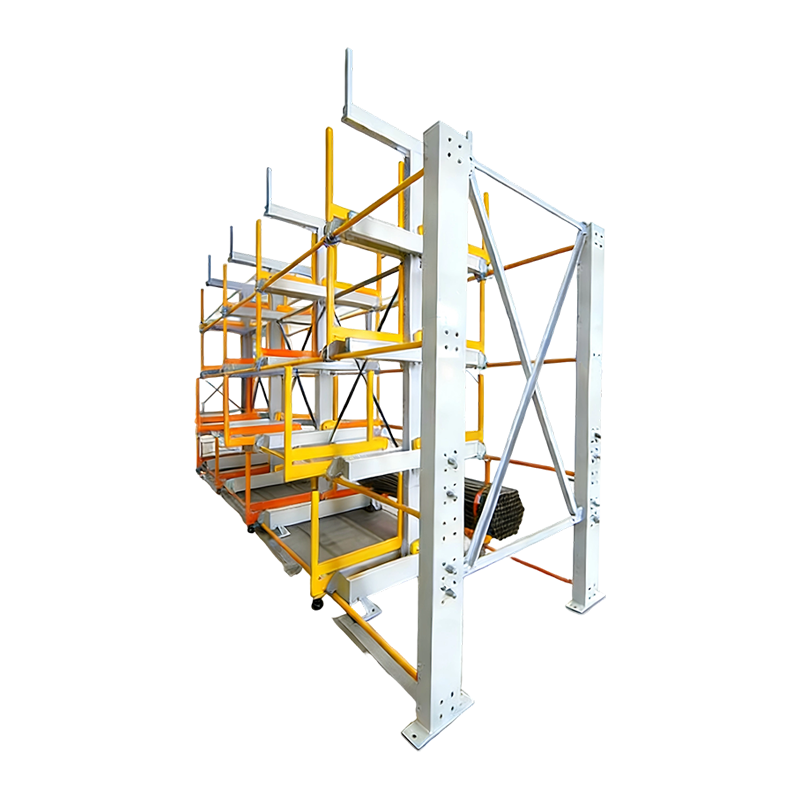
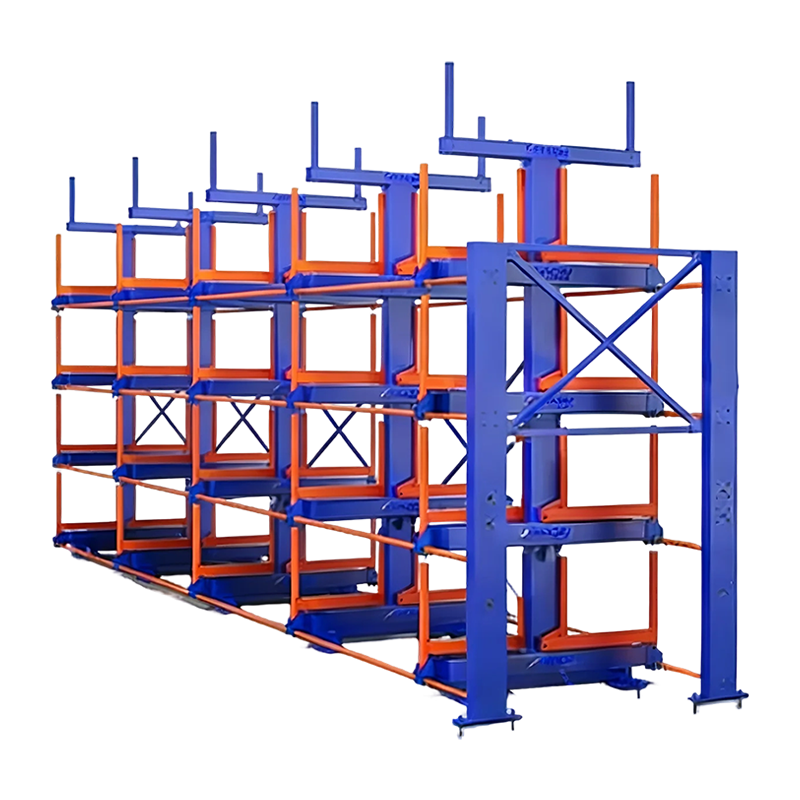
- Mobile cantilever: Single or double-sided units mounted on floor rails with electrical drive. Aisles are created only when access is needed, increasing density by 30–50% over static systems in equivalent floor area.
Cantilever systems comply with structural performance standards including ANSI/RMI MH16.1, which governs load ratings, deflection limits, and column design for industrial rack systems. Facilities should request engineering documentation showing compliance with this standard—and local seismic requirements where applicable—before purchasing any cantilever installation. Explore our full range of long material storage rack systems, including single-sided, double-sided, and heavy-duty configurations for both indoor and outdoor applications.
Honeycomb and Pigeonhole Systems: Maximum Storage Density
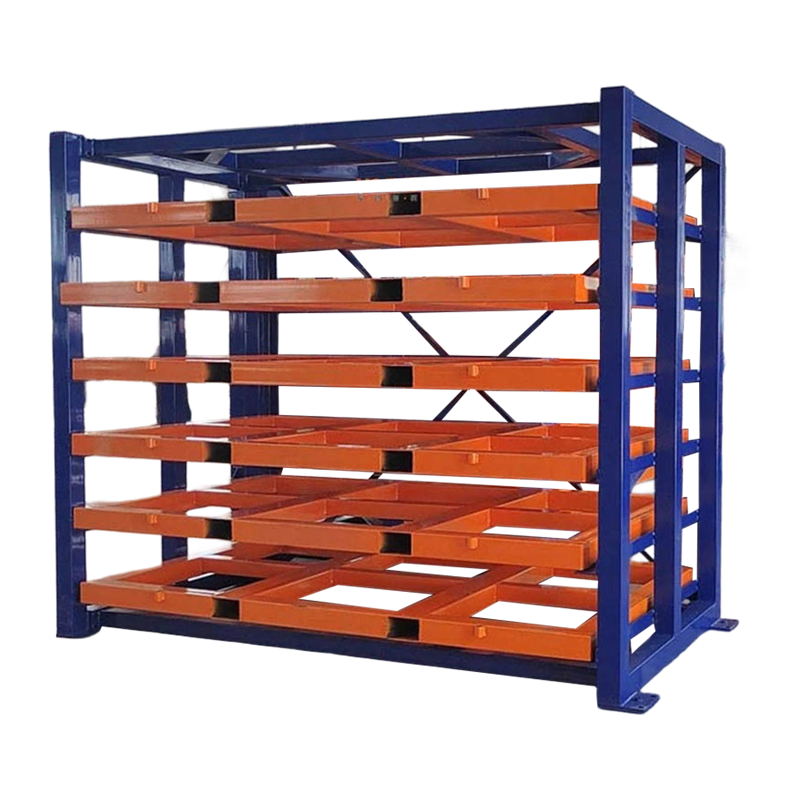
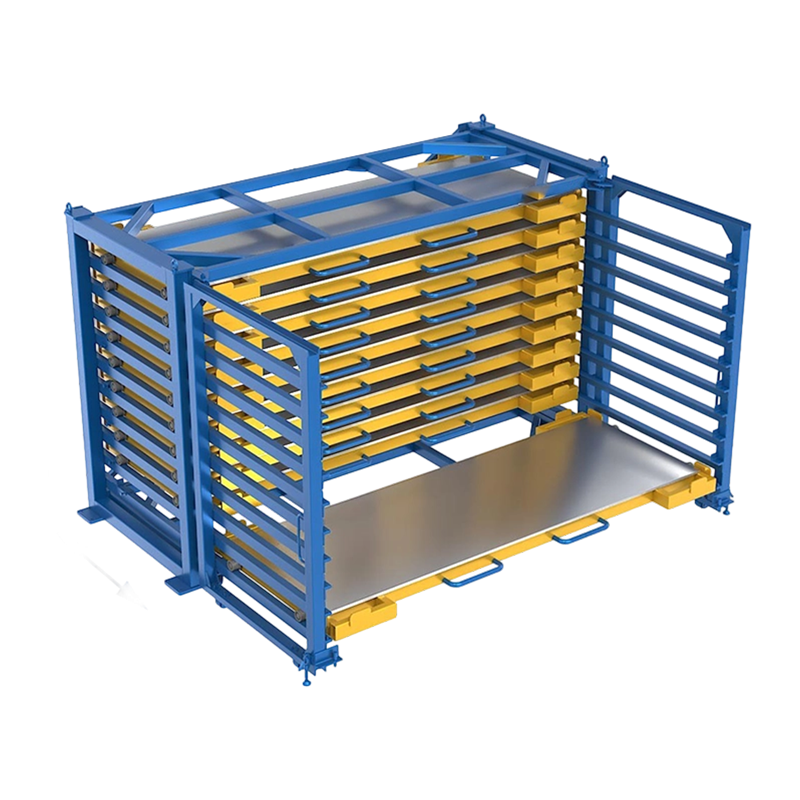
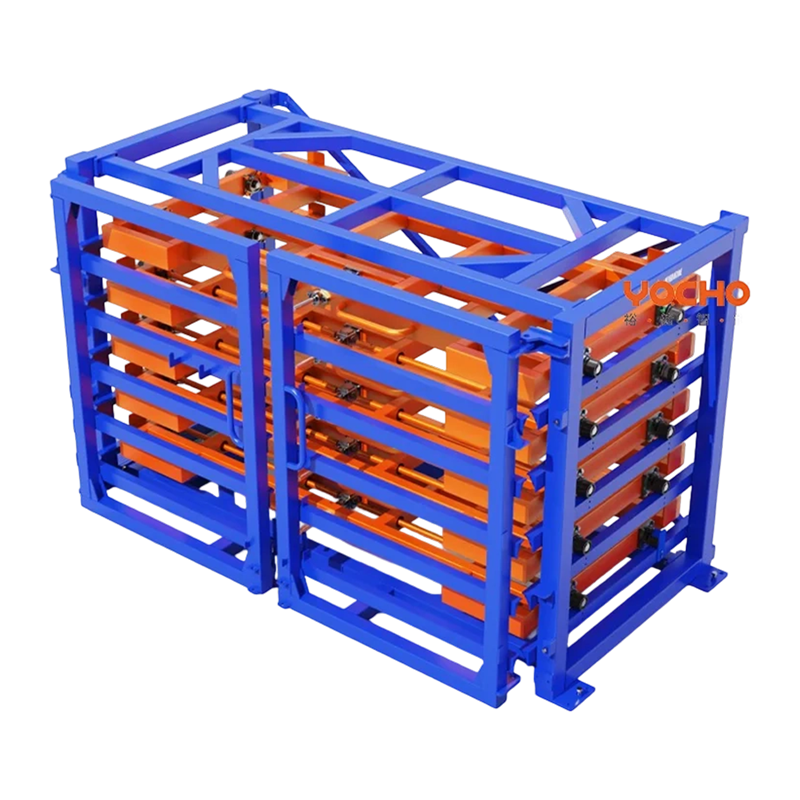
Where cantilever racking stores multiple pieces per arm level and retrieves them with a forklift or crane, honeycomb storage assigns each individual bundle, bar, or length its own dedicated horizontal channel. The system is a grid of square or round tubes—typically 150 mm to 400 mm in cross-section—stacked in a structural frame and accessed from the front face by a specialized retrieval cart, sideloader, or automated extractor.
The density advantage is significant: a honeycomb system in a given floor footprint can store two to four times the number of individual line items compared to cantilever racking covering the same area, because the vertical space is utilized fully with no wasted gaps between arm levels. Every channel position is a discrete inventory location with an assigned address, enabling barcode or RFID-based piece-level tracking that is impossible in a cantilever environment where multiple pieces share an arm.
The trade-off is inflexibility in compartment dimensions. Each channel is sized for a specific cross-section range. A facility storing a wide variety of material profiles—square bar, round tube, flat strip—requires a proportionally complex channel size mix, and adding new material profiles may require additional frame sections rather than simple arm repositioning. Honeycomb systems are most productive in metal service centers, distribution warehouses, and fabrication operations with stable, well-defined inventory profiles and high pick frequency.
Honeycomb storage is also the foundation architecture for most automated long load retrieval systems, where the channel grid serves as the storage medium and a machine carriage handles extraction and delivery automatically.
Automated Long Load Storage Solutions
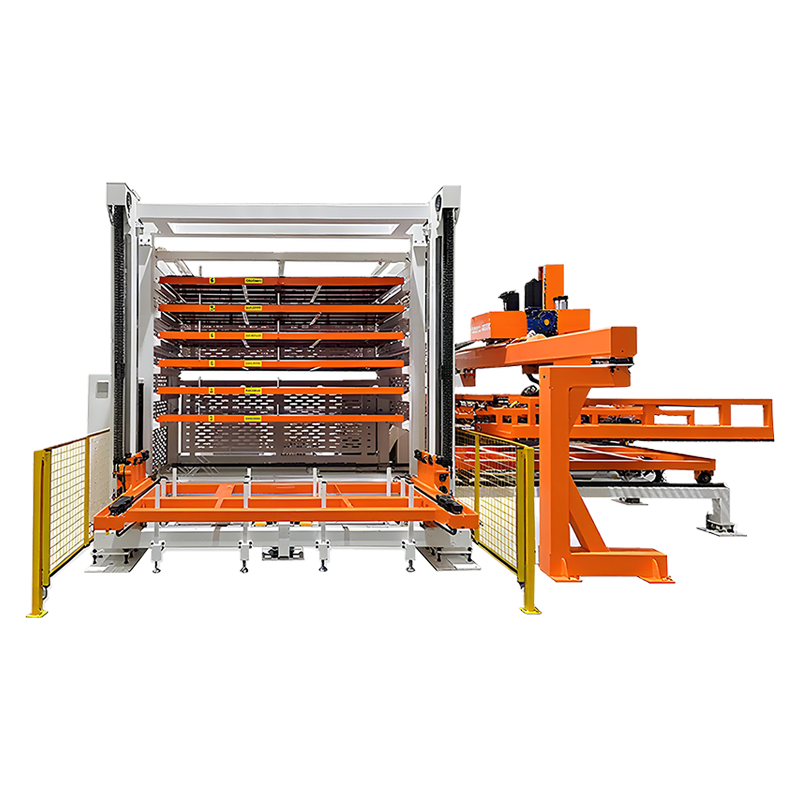
Automated long load storage systems (ALSS)—sometimes called automated pipe or bar storage systems—combine a honeycomb or cantilever-analog storage structure with a computer-controlled retrieval mechanism that locates, extracts, and delivers a specified bundle or length to a designated output station without operator intervention in the storage zone. The operator interacts only at the output point, eliminating the time and risk associated with navigating a forklift through a racking aisle to locate and extract a specific piece.
The operational advantages compound across three dimensions:
- Labor efficiency: A single operator at the output station can manage material flow that would otherwise require two or three forklift operators working the storage aisles. In operations running multiple shifts, the labor cost reduction alone typically delivers payback within 18–36 months on medium-to-large installations.
- Storage density: Because aisles for forklift navigation are eliminated, automated systems can store material at densities 60–80% higher than equivalent manual cantilever installations in the same building footprint.
- Inventory accuracy: Every extraction and return is recorded by the system's warehouse management software (WMS). Weight-based or length-based verification at the output station ensures that the correct material has been retrieved and that inventory records are updated in real time—a level of accuracy that manual operations cannot sustain consistently.
Automated systems represent a significant capital investment and are most justifiable in facilities with high daily pick volumes, expensive or difficult-to-source material inventory where errors are costly, or labor markets where skilled forklift operators are scarce or expensive. For sheet metal and flat stock automation, our automated sheet metal storage systems deliver the same principles of density and precision retrieval applied to flat material formats.
Key Selection Criteria: A Decision Matrix
Most facilities do not need the most sophisticated system available—they need the system that best matches their specific operational profile. Four variables drive the selection decision:
| Variable | Cantilever | Honeycomb | Vertical | Dynamic Flow | Automated |
|---|---|---|---|---|---|
| Max. piece weight | Up to 15,000+ kg | Up to 5,000 kg | Up to 3,000 kg | Up to 2,000 kg | Up to 10,000+ kg |
| Max. piece length | Unlimited | Up to 12 m (typical) | Up to 6 m | Up to 9 m | Up to 12 m |
| SKU variety | High (flexible) | Very high (individual locations) | Medium | Low–Medium | High (software-managed) |
| Retrieval equipment | Forklift / crane | Sideloader / cart | Manual / crane | Forklift / manual | Automated (no forklift in storage) |
| Capital cost tier | Low–Medium | Medium | Low | Medium | High |
| Best fit operation | Steel yards, lumber, pipe distribution | Metal service centers, bar/profile stock | Workshops, fabrication cells | High-turnover FIFO operations | High-volume, multi-shift, precision inventory |
A practical selection shortcut: if your operation retrieves material more than 15–20 times per shift and accuracy errors are costly, evaluate automated systems. If retrieval frequency is lower and the inventory mix changes frequently, cantilever racking offers the best combination of capacity, flexibility, and capital efficiency. For most metal storage, fabrication, and distribution operations, our long material storage rack range covers the cantilever and structural configurations that address the broadest range of industrial storage requirements.
Floor Space vs. Vertical Space: Calculating the ROI
The return on investment for long loads storage racking is most clearly demonstrated by converting the floor space freed by racking into a dollar-per-square-meter value and comparing it against the annualized system cost.
Consider a typical metal service center scenario: a 2,000 m² warehouse floor where 600 m² is currently occupied by floor-stacked long material inventory. Installing double-sided cantilever racking in a 200 m² footprint (four rows of racking with access aisles) can accommodate the same material volume that previously required 600 m², recovering 400 m² of usable floor space. At an industrial warehouse lease rate of $80 per m² per year, that recovered space represents $32,000 in annual floor cost reduction—before accounting for reduced material damage, lower injury rates, faster retrieval times, and improved inventory accuracy.
Vertical space utilization compounds this calculation further. A standard industrial building with a 9-meter clear height can accommodate cantilever racking to 7–8 meters, stacking multiple arm levels in the same floor footprint. A single 6-meter column section with six arm levels at 1,200 mm spacing stores material in a vertical volume that would require floor stacking across an area many times larger.
The ROI calculation for automated systems extends this further: reduced labor cost, near-zero retrieval errors, and improved material turnover velocity are operational gains that compound annually. For high-volume operations processing more than 500 picks per day, the total cost of ownership over a 10-year period frequently favors automation over the ongoing labor cost of manual cantilever operations.

If you are interested in our products, please consult us
PRODUCTS
NEWS CENTER
MOBILE TERMINAL

CONTACT US
- ADDRESS: Room 205, Office Building, Shandong Yurui Machinery Group Co., Ltd., at the intersection of Banqiao Road and Huangjin Road, Pingyi Street, Pingyi County, Linyi City, Shandong Province.
- PHONE: +86-19819101584
- EMAIL: [email protected]
Linyi Yocho Storage Intelligent Manufacturing Co.,Ltd. ALL RIGHTS RESERVED. ALL RESERVED. Warehouse Rack Manufacturers Warehouse Shelves Factory
